Canon Cinema EOS C400 Officially Announced !
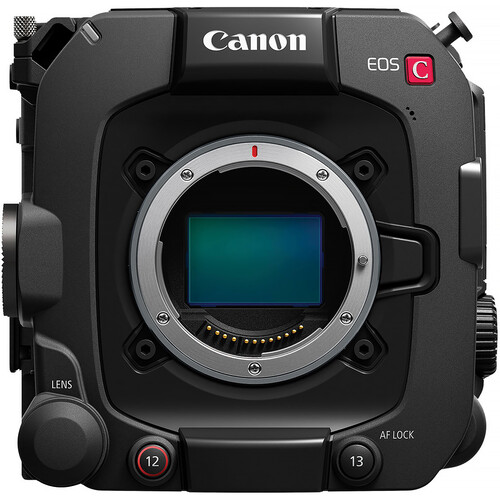
Canon, a leader in digital imaging, has just unveiled groundbreaking additions to its cinema lineup – the EOS C400 camera and a native RF mount CINE-SERVO 17-120mm lens. These new products, slated for release in late 2024, demonstrate Canon’s ongoing commitment to providing filmmakers and videographers with top-of-the-line tools for capturing stunning visual content. You can now pre-order EOS C400 at B&H Photo Video.
The star of the show is undoubtedly the EOS C400, Canon’s first cinema camera to feature a full-frame, back-illuminated stacked CMOS sensor. This 6K powerhouse promises to deliver exceptional image quality across a wide range of lighting scenarios thanks to its triple-base ISO (800, 3200, 12800) that maximizes dynamic range. The stacked sensor architecture also enables more efficient light capture, faster readout speeds, and superior 4K resolution from 6K oversampling.
But the EOS C400’s sensor innovations don’t stop there. Filmmakers will appreciate the camera’s support for Canon’s next-gen Dual Pixel CMOS Autofocus system, Dual Pixel AF II. By leveraging the back-illuminated stacked design, a larger portion of the sensor can now be utilized for highly responsive autofocusing. This is a huge win for solo operators and small crews who need reliable AF performance.
When it comes to recording options, the EOS C400 goes above and beyond. 6K full frame recording at up to 60p in 12-bit Cinema RAW Light will please detail-obsessed cinematographers. Changing the sensor mode allows high-speed capture at 4K 120fps and 2K 180fps. Canon’s latest Cinema RAW Light codec provides three compression choices to optimize file size and post-production workflow.
If RAW feels like overkill, 10-bit 4:2:2 XF-AVC recording up to 120p offers a happy medium, with oversampling from the 6K sensor for crisp, detailed images without cropping. Canon has also introduced XF-AVC S and XF-HEVC S codecs for smaller file sizes in an edit-friendly MP4 container while retaining metadata. Dual card slots (1 CFexpress, 1 SD) enable simultaneous recording of proxies or backups.
The EOS C400 is clearly aimed at high-end productions, but it holds plenty of appeal for broadcast and live event workflows too. The camera body sports a 12-pin lens terminal for servo zoom control, plus a slew of connectivity options: mini-XLR audio, timecode/genlock/return video via DIN, 12G/3G-SDI, HDMI, Wi-Fi, and Ethernet. The SRT protocol allows for high-quality video and audio streaming over IP.
Remote operation is a breeze thanks to Wi-Fi, Ethernet, the Canon Multi-Camera Control app, and full compatibility with Canon’s RC-IP100/RC-IP1000 controllers. On-set virtual production receives a boost with real-time frame-by-frame metadata output. The EOS C400 even offers a dedicated VR mode when paired with Canon’s RF5.2mm F2.8 L dual fisheye lens.
Joining the EOS C400 is a new RF mount version of Canon’s popular CINE-SERVO 17-120mm T2.95 lens. While it shares the outstanding optics of the original, the RF mount’s extra contacts allow for enhanced metadata communication, iris control, and distortion correction with cameras like the C400. Focus breathing compensation and improved focus/iris response are made possible by the updated eXsV servo drive unit. For added versatility, the lens will be available in both RF and PL mounts.
Existing PL mount lens owners haven’t been forgotten either. Canon’s new PL-RF Mount Adapter ensures compatibility across a broad range of glass while maintaining support for Cooke i/Technology metadata. Robust locking plates guarantee a rock-solid connection between lens and camera.
Pricing:
The Canon Cinema EOS C400 Full-Frame RF Mount Camera is scheduled to be available in September 2024 for an estimated retail price of $7,999.00*. The CINE-SERVO 17-120mm will be available in October 2024 for an estimated retail price of $23,850.00*. The MOUNT ADAPTER PL-RF will be available in September 2024 for an estimated retail price of $1,599.00.
With the EOS C400, Canon has thrown down the gauntlet in the full-frame digital cinema arena. Its cutting-edge sensor, impressive recording options, and support for bleeding-edge production techniques points to a bright future for Canon’s Cinema EOS system. For filmmakers seeking uncompromising performance and flexibility, the C400 may be tough to beat.